
Armstrong County Court Records After a Jail Arrest
Court records after a jail arrest in Armstrong County follow a sequence that is easy to confuse with the jail roster. An arrest leads to booking at the custody level. A first appearance or preliminary arraignment addresses immediate issues such as identity, charges, bail, and release conditions. The prosecutor then decides what charges to file or approve, and that filing is what opens or advances the court case record. The public court docket is therefore a case-management record, not a live jail-housing record.
For custody status, booking date, and roster fields, the separate jail inmate records page is the better starting point. For booking-photo questions, use the jail mugshots page. Court records after an arrest focus on the legal case: docket number, offense descriptions, grading, scheduled events, bail entries, warrants, dispositions, and later post-disposition activity. A person may be released from jail while the court record remains active, and a charge may appear in court even after a booking record is no longer visible online.
How to Find Armstrong County Court Records After an Arrest
The statewide entry point is Pennsylvania UJS Case Search. It supports search modes for Appellate, Attorney, Calendar Event, Citation Number, Complaint Number, Date Filed, Docket Number, Incident Number, Organization, OTN, Parcel, Participant Name, SID, and other court-related identifiers. For a recent jail arrest, the most practical options are usually Participant Name, Docket Number, Complaint Number, OTN, Incident Number, or Calendar Event once a court date exists.
- Open UJS Case Search and choose the search mode that matches the information available.
- Search by participant name when no docket number is known, using spelling variations if needed.
- Open the matching docket sheet and confirm county, court level, date filed, and party details before relying on the result.
- Read each charge entry separately, because one arrest can produce multiple counts with different grades, statuses, and outcomes.
UJS docket sheets cover Pennsylvania appellate courts, criminal courts of common pleas, magisterial district courts, and Philadelphia Municipal Court. Armstrong County criminal cases, civil matters, divorce filings, judgments, and liens are routed by the county Right-to-Know information to the Prothonotary and Clerk of Courts. District court matters are handled by the respective magisterial district judge offices. A UJS docket is not the same thing as a Pennsylvania State Police PATCH criminal-history check, and it should not be treated as a complete criminal-history report.
The UJS Case Search interface is the statewide portal used for court records after an arrest in Pennsylvania.
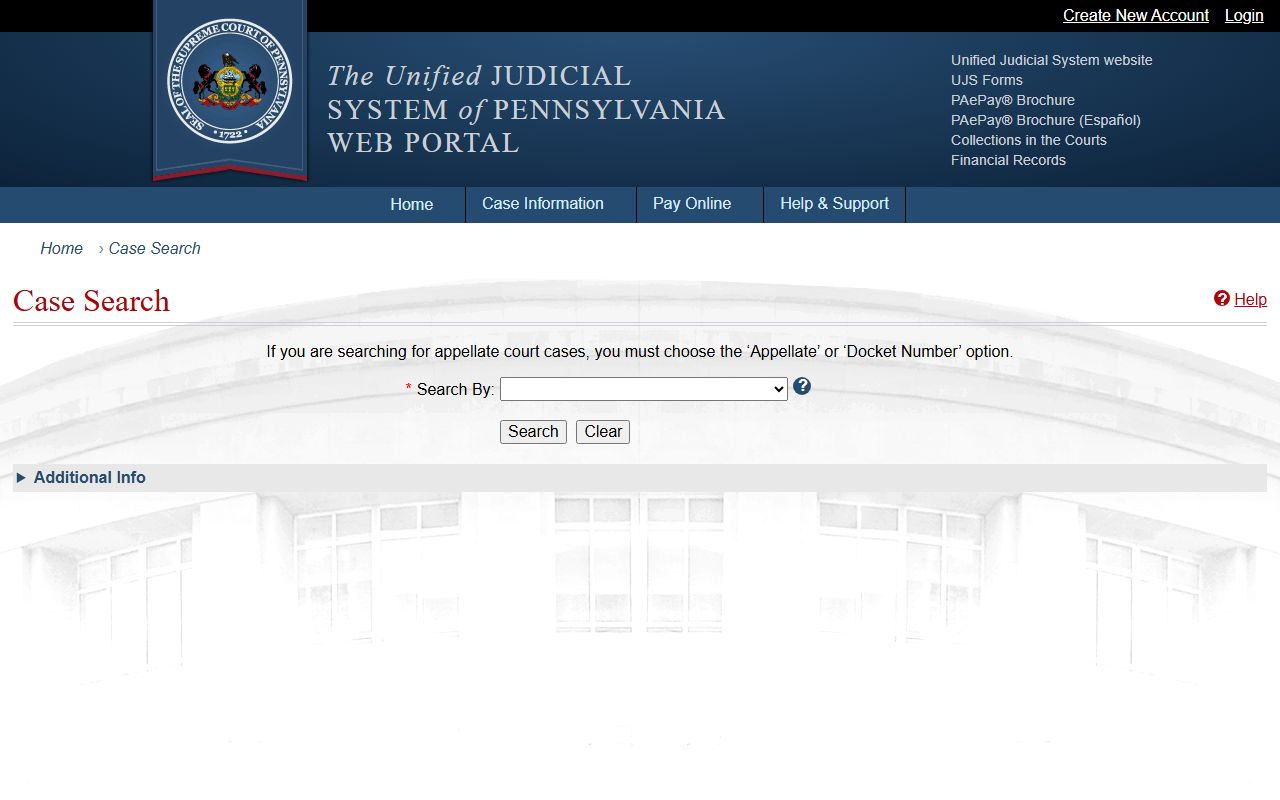
The search-mode list matters in Armstrong County because a jail arrest may be traceable by a name at first, then by complaint number, docket number, OTN, or scheduled court event after filings are processed.
Armstrong County Court, Records, and Arrest Filing Offices
The Armstrong County Prothonotary and Clerk of Courts office is headed by Annette Bowser and is located at 500 E. Market Street, Suite 103, Kittanning, PA 16201. The office phone number is 724-548-3252. Public hours are 8:00 a.m. to 4:30 p.m., Monday through Friday, with the office closed from noon to 1:00 p.m. That office is the local routing point identified for criminal cases, civil cases, divorce matters, judgments, and liens.
The Armstrong County District Attorney is Katie M. Charlton. The District Attorney's Office is at 500 E. Market Street, Suite 323, Kittanning, PA 16201. The phone number is 724-548-3240, the fax number is 724-548-3485, and the listed email address is kmcharlton@co.armstrong.pa.us. Some local filings are screened under Pennsylvania Rules of Criminal Procedure 202 and 507 certifications, so a court record after a jail arrest may reflect prosecutor review before certain complaints move forward.
How Charges Become Court Records After an Arrest
The case path is arrest, booking, first appearance, prosecutor filing, and court case opening. Booking records document the custody intake. Court records document the legal accusation and case events. In Pennsylvania criminal practice, the early charging paper may be a criminal complaint, and later common pleas filings may include an information after a case is held for court. The exact filing depends on the court level and case stage.
| Document or Event | Who Handles It | What It Does |
|---|---|---|
| Criminal complaint | Law enforcement, with prosecutor review where required | States the alleged offenses and begins the criminal case track in the proper court. |
| Preliminary arraignment or first appearance | Magisterial district judge | Addresses the filed allegations, bail, release conditions, and next hearing dates. |
| Information | District Attorney | Sets out charges proceeding in the Court of Common Pleas after the case is bound over. |
| Docket sheet | Unified Judicial System and local court offices | Shows case events, charges, filings, bail entries, court dates, and dispositions. |
Charge Status in Court Records After a Jail Arrest
Charges can change after an arrest because the booking accusation is not the final word on the case. A prosecutor may file fewer counts, add counts, amend grades, withdraw allegations, or proceed only on charges supported by the available evidence. A docket should be read count by count, especially when one incident has several charges with different results.
| Status | What It Means |
|---|---|
| Pending | The charge remains active and has not yet reached a final disposition. |
| Held for court | A magisterial district proceeding sent the charge forward to the Court of Common Pleas. |
| Amended or reduced | The charge description, grade, or count changed from an earlier filing. |
| Dismissed or withdrawn | The charge did not continue, although other counts in the same case may remain active. |
| Nolle prosequi | The prosecutor declined to continue prosecution on that charge, subject to court procedure. |
Bail and Release in Court Records After an Arrest
Bail entries connect the jail arrest to the court case. A magisterial district judge or court may set monetary bail, release on recognizance, nonmonetary conditions, or a no-bail status depending on the case. Armstrong County lists surety bond agencies by county, and property bond questions are routed to the Prothonotary. Magistrate fines may be paid at the jail 24 hours a day by cash or money order; personal checks are not accepted. Calling ahead is important because the amount must be confirmed before payment.
| Bail or Hold Type | How It Affects Release |
|---|---|
| Surety bond | A licensed bonding agency may post bail under the court's terms. |
| Property bond | Questions are directed to the Armstrong County Prothonotary because real property is involved. |
| Cash or money-order payment | Magistrate fines can be paid at the jail, but the amount should be verified first. |
| Hold, detainer, or no-bond order | Release can be blocked even if another charge appears payable or resolved. |
Warrants, Court Records, and Arrest Follow-Up
Warrants can create the arrest event that later becomes a court record. Armstrong County's public CRIMEWATCH warrant page lists wanted entries with names, charges, and failure-to-appear summaries. Those entries are warrant notices, not a full docket and not a jail roster. The sheriff serves warrants, and the court docket should be checked separately for case status, hearing activity, and disposition.
The Armstrong County CRIMEWATCH warrants page is useful for public warrant context before or after a jail arrest.
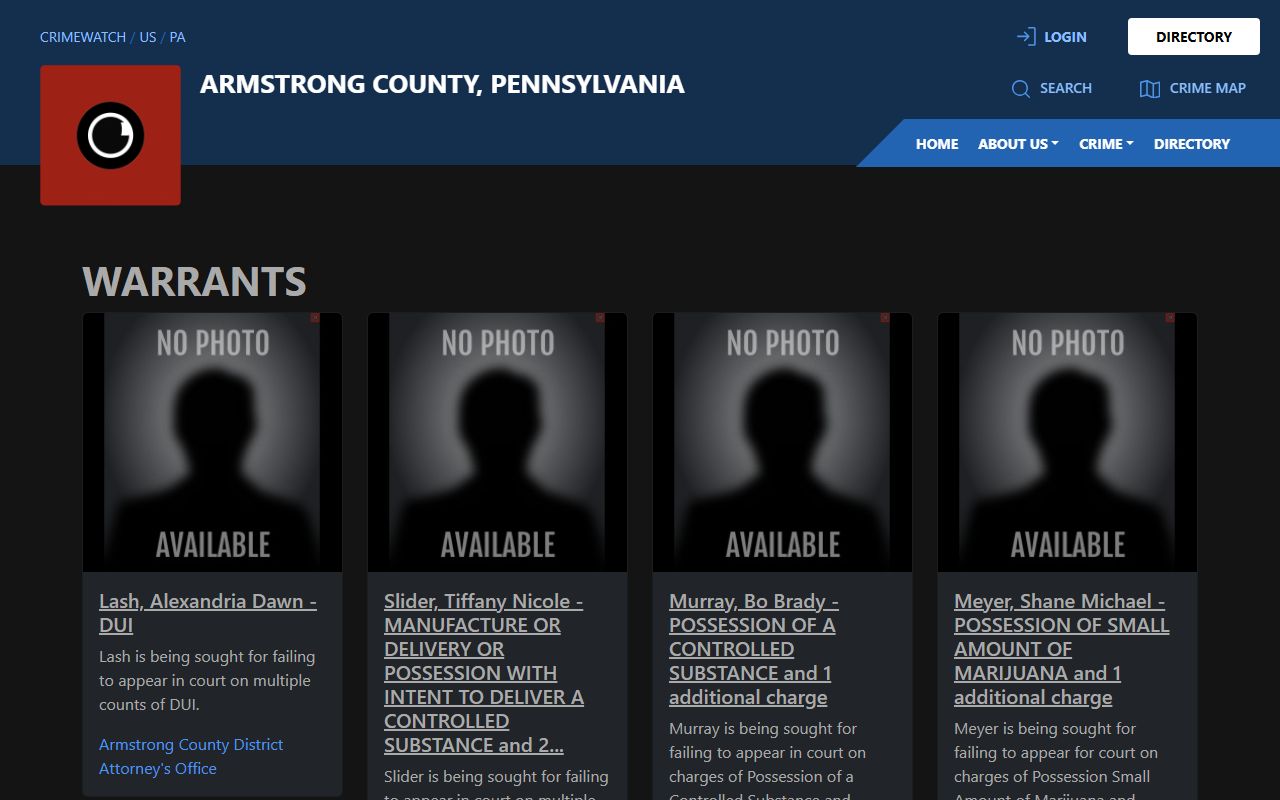
A CRIMEWATCH entry may explain why a person was wanted, while the UJS docket and local court offices show how the filed case proceeds after arrest.
Charges vs. Convictions in Armstrong County Court Records
A charge is an accusation filed in court after an arrest. A conviction is a final result after a guilty plea, verdict, or other qualifying disposition. Public readers should not treat a charge entry, warrant notice, or booking record as proof that the person was convicted. The docket must be read through the final disposition and sentencing entries, if any.
| Charge | Conviction | |
|---|---|---|
| Stage | Accusation after filing | Final adjudication or plea result |
| What to Check | Count, grade, filing date, and current status | Disposition, sentence, and post-sentence activity |
| Public Meaning | Shows the case allegation | Shows a proven or admitted outcome |
Sealed vs. Expunged Arrest and Court Records
Pennsylvania law includes expungement procedures under 18 Pa.C.S. § 9122. Expungement is not the same as an online correction request, and it generally requires action through the court or the originating criminal-justice agencies. The Pennsylvania Right-to-Know Law, 65 P.S. § 67.101 et seq., creates a public-records process, but that process is subject to exemptions. CHRIA, 18 Pa.C.S. Chapter 91, governs criminal history record information and limits how some criminal justice information may be disseminated.
| Sealed or Restricted | Expunged | |
|---|---|---|
| Public Visibility | May be hidden or limited from ordinary public access. | May be removed or treated as cleared under the court order and applicable law. |
| Where to Start | Review the docket and ask the court office what access rule applies. | Use the statutory and court process tied to the underlying case. |
| Effect on Websites | Restrictions may not automatically change every third-party copy. | Send the completed order to the agencies or offices that maintain the affected records. |
Background Check Considerations After a Court Record or Arrest
A UJS docket search is a public court-record lookup, not a substitute for an authorized background check. Employers, landlords, insurers, lenders, and other regulated users must use proper FCRA-compliant screening channels and follow applicable federal and state law. For Pennsylvania criminal-history checks, the PSP PATCH system is a separate criminal-history process from UJS docket viewing.
Important: This site is not a consumer reporting agency and may not be used for FCRA-covered screening decisions.
Restricted Court Records After an Arrest in Armstrong County
Not every arrest-related record is publicly available. Juvenile matters, sealed filings, expunged cases, protected victim information, certain investigative records, and records controlled by CHRIA may be withheld or restricted. A docket may show less than the full agency file, and a records office may deny or redact material when a statutory exemption applies. When a public record is missing from a search result, the next step is usually to confirm the court level, office of record, and access rule rather than assuming no case exists.